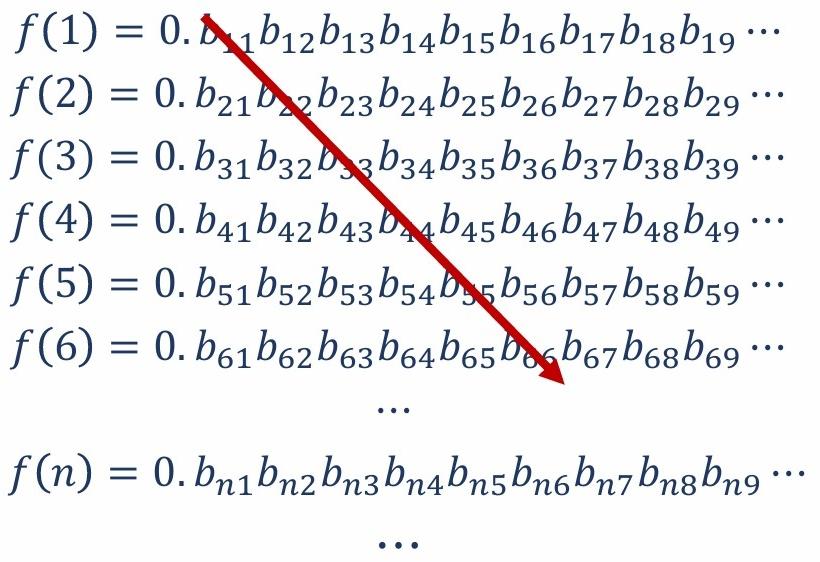
Cantor’s Diagonal Argument
1890/91, Cantor (1845-1918)
THEOREM:
- Suppose that . Then there is a bijection
- Let for
- is in
- must have a preimage
- however, for every
- cannot be a bijection
Cantor’s Theorem
THEOREM (Cantor) Let be any set. Then .
- : the power set of a set , i.e., the set of all subsets of
- For example:
- The function defined by is injective.
- Assume that there is a bijection
- Define two lists () and ()
- Define
- We must have that .
- for some
- If , then
- If , then
The Halting Problem
Function
- : a program; : an input to the program .
QUESTION: Is there a Turing machine computing ?
- Turing machine: can be represented as an element of
- : the set of all finite bit strings
THEOREM: There is no Turing machine computing .
- Assume there is a Turing machine computing
- Define a new Turing machine that runs on any Turing machine
- If “halts”, loops forever
- If “loops forever”, halts
- loops forever “halts” halts
- halts “loops forever” loops forever
Countable and Uncountable
DEFINITION: A set is countable if or ; otherwise, it is said to be uncountable.
- countably infinite:
EXAMPLE: are countable; are uncountable.
THEOREM: A set is countably infinite if and only if its elements can be arranged as a sequence
- If is countably infinite, then there is a bijection
- for every
- If , then the defined by is a bijection
THEOREM: Let be countably infinite, then any infinite subset is countable.
- Let . Then
THEOREM: Let be uncountable, then any set is uncountable.
- If is countable, then is finite or countably infinite
THEOREM: If are countably infinite, then so is
- // no elements will be included twice
- Application: the set of irrational numbers is uncountable
THEOREM: If are countably infinite, then so is
Schröder-Bernstein Theorem
QUESTION: How to compare the cardinality of sets in general?
THEOREM: If and , then .
EXAMPLE: Show that
- is injective
- is injective
EXAMPLE:
- is an injection.
- (, no )
- has a binary representation
- is an injection
THEOREM:
The Continuum Hypothesis: There is no cardinal number between and , i.e., there is no set such that .
Basic Rules of Counting
DEFINITION: Let be a finite set. A partition of set is a family of nonempty subsets of such that
- for all with .
The Sum Rule: Let be a finite set. Let be a partition of . Then .
The Product Rule: Let be finite sets. Then .
The Bijection Rule: Let and be two finite sets. If there is a bijection , then .
Permutations of Set
DEFINITION: Let and . An -permutation of is a sequence of distinct elements of A.
- An -permutation of is simply called a permutation of .
- The 2-permutations of are ; ; ; ; ;
THEOREM: An -element set has different -permutations.
DEFINITION: Let and . An -permutation of with repetition is a sequence of elements of .
- The 2-permutations of with repetition are:
- ; ; ; ; ; ; ; ;
THEOREM: An -element set has different -permutations with repetition.
Multiset
DEFINITION: A multiset is a collection of elements which are not necessarily different from each other.
- An element has multiplicity if it appears times in .
- A multiset is called an -multiset if it has elements.
- : an -multiset
- has multiplicity for all .
- is called an -subset of if:
- for every , and
EXAMPLE: ,
- is a 106-multiset; the multiplicities of are , respectively.
- is a 99-subset of
Permutations of Multiset
DEFINITION: Let be an -multiset. A permutation of is a sequence of elements, where appears exactly times for every .
- -permutation of : a permutation of some -subset of
- Example:
- is a permutation of ; is a 3-permutation of ;
THEOREM: Let be a multiset. Then has exactly permutations.
REMARK: Let be a set of elements.
- -permutation of w/o repetition: -permutation of .
- -permutation of with repetition: -permutation of .


有没有更直观的图来解释这个方法啊?
这证明绕得我头晕,直接记结论算了
所以无穷大还分等级?有点颠覆认知
感觉数学就是在证明各种反直觉的事
对啊,正是这种反直觉让人又爱又恨。
对角线法到底啥原理,求个通俗解释
实数比整数多?那我数数能力有问题?
别急,数不完的不是你,是那无限的集合。
之前学到这里直接放弃,现在还是没懂
这图看得我头大,数学太难了😵
我曾经在自学集合论时卡在对角线构造上,反复画图才悟到每位数字都要翻转,过程虽绕但真的很有成就感。
如果把(0,1)换成[0,1],结论还能成立吗?
结论记住了,过程放弃了,考试别考太细就行。
函数f的定义怎么保证是单射?求详细解释。
数学课上这段,老师都不敢讲。
有更通俗的解释吗?这种证明太抽象了。
实数比整数多,那有没有比实数还多的?
纯数学劝退,看不懂直接跳过。
图里那个对角线数字改来改去,到底想说明啥?
以前卡这几天,这次总算抓住要点。
对角线法每次看都懵,脑子转不过弯。
看完直接想把实数装进口袋,笑。
这图真是脑洞大开,直接惊到我 😂
以前学这部分卡了好几天,今天重新看才明白,原来是利用无限二进制展开制造新数,真是脑洞大开。
我刚刚复习了集合论,发现对角线法的核心是找不到对应的列表。
对角线证明真是脑洞大
连续统假设这玩意没定论?
有理数居然可数…以前完全没想过
第一次听说确实挺反直觉
多重集那个公式看着眼熟,但细节还是蛮绕的。
原来无限还能比大小,离谱
我第一次看的时候也懵了