L11 – Catalan number and T-routes
5,680字
24–36 分钟
Catalan Number
Triangulation of Convex Polygons
: convex -polygons (interior angles , vertices point outward)

DEFINITION: A triangulation of is a set of diagonals of which do not cross in their interiors.
The th Catalan Number (Euler, 1751): # of triangulations of

Earlier findings: Ming Antu (1692-1763) in Qing court (China), established the following formula in “Quick Methods for Accurate Values of Circle Segments”:
Recurrence Relation: ,
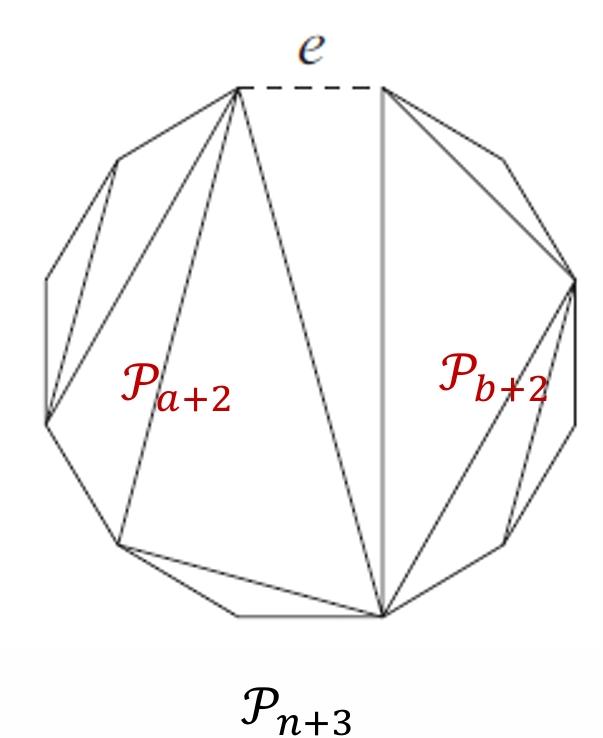
- has triangulations
- After removing an edge , each triangulation of gives
- a triangulation for and a triangulation for
Binary Trees
DEFINITION: A binary tree is defined recursively as follows.
- The empty set is a binary tree.
- Otherwise, a binary tree has a root vertex , a left subtree , and a right subtree , both of which are binary trees.
- left child: the root of ; right child: the root of
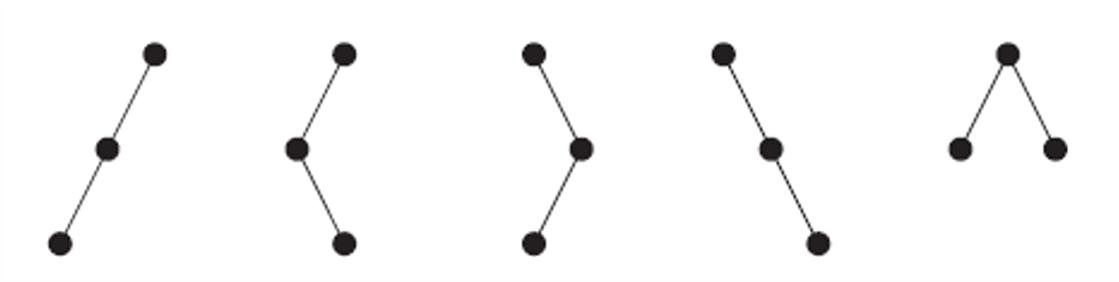
THEOREM: The number of binary trees with vertices is
- proof is omitted
Plane Trees
DEFINITION: A plane tree (ordered tree) is defined recursively as follows.
- A single vertex is a plane tree. And the vertex is called the root of the tree.
- Otherwise, a plane tree has a root vertex , and a sequence of subtrees, each of which is a plane tree.
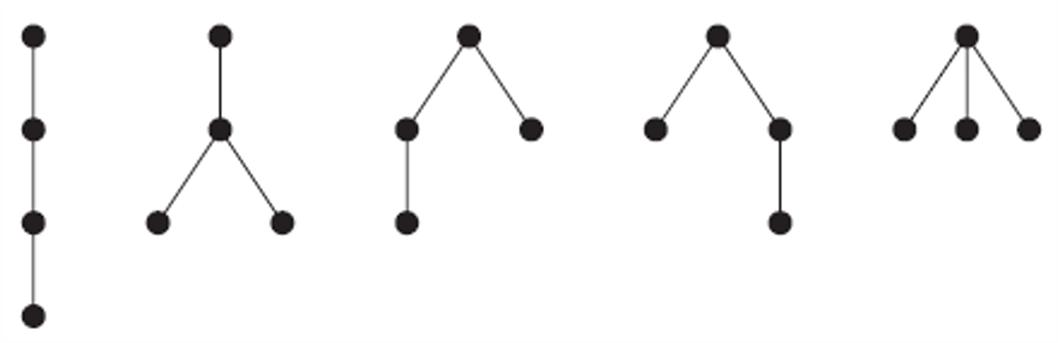
THEOREM: The number of plane trees with vertices is .
- proof is omitted
Parenthesization
DEFINITION: A parenthesization (or bracketing) of a string of symbols consists of the insertion of left parentheses and right parentheses that define binary operations on the string.
- Eugêne Charles Catalan (1814-1894) studied this problem in 1838
EXAMPLE: There are five parenthesizations on four symbols
- ;
- ;
- ;
- ;
THEOREM: The number of parenthesizations of a string of symbols is .
- proof is omitted
Ballot sequence
DEFINITION: A ballot sequence of length is a sequence of ‘s and ‘s, where
- the number of ‘s is equal to the number of ‘s; and
- the sum of every prefix of the sequence is nonnegative.
Bertrand’s Ballot Problem (special case): There are two candidates A and B in an election. Each receives votes. What is the probability that A will never trail B during the count of votes?
- First published by W. A. Whitworth (1840-1905) in 1878
- Named after Joseph Louis Francois Bertrand (1822-1900) who rediscovered it in 1887.
EXAMPLE: AABABBBAAB is bad, since among the first 7 votes, A receives 3 but B receives 4 , which is greater than 3.
THEOREM: The number of Ballot sequences of length is .
- proof is omitted
Dyck path
DEFINITION: A Dyck path of length is a sequence , , of lattice points (points with integral entries) such that
- for all
- for all

THEOREM: The number of Dyck paths of length is .
REMARK: Dyck path may be called T-route generally. The name of “Dyck path” is in memory of German mathematician Walther von Dyck (1856-1934)
Shortest Path
DEFINITION: A -grid is a collection of squares of side length 1, organized as a rectangle of side length and .
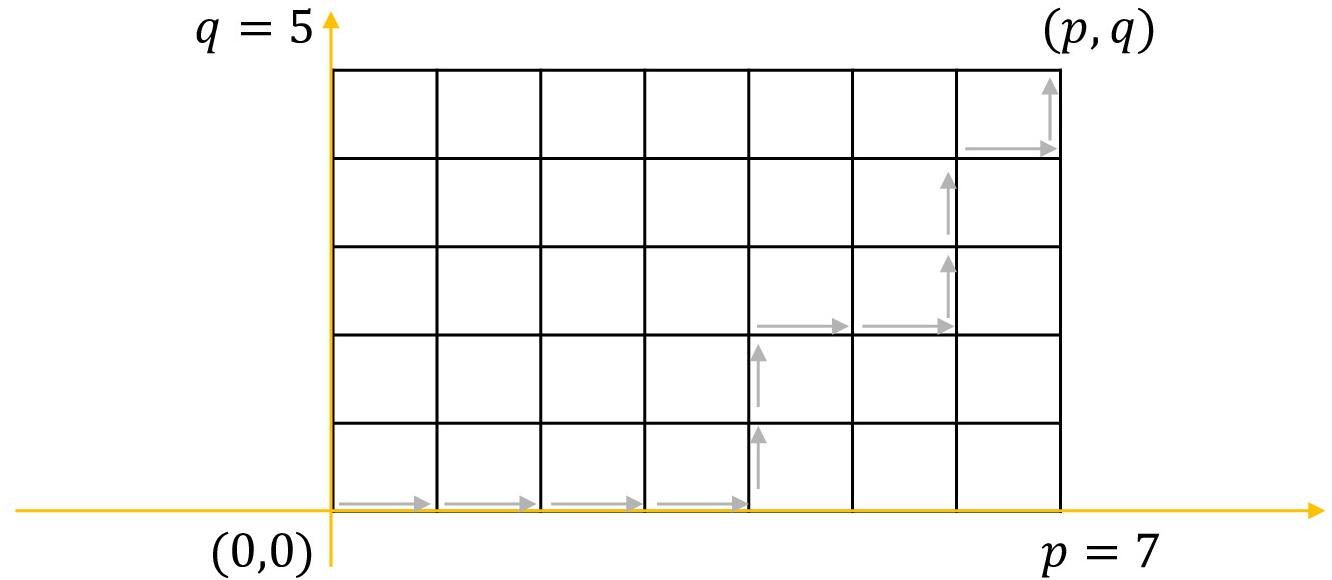
THEOREM: The number of shortest paths from to is .
- Let be a -multiset.
- The number of shortest paths the number of permutations of .
T-Route
DEFINITION: Let . // integral (lattice) points
- A T-Step at is a segment from to or .
- A T-Route from to is a route where each step is a T-step.
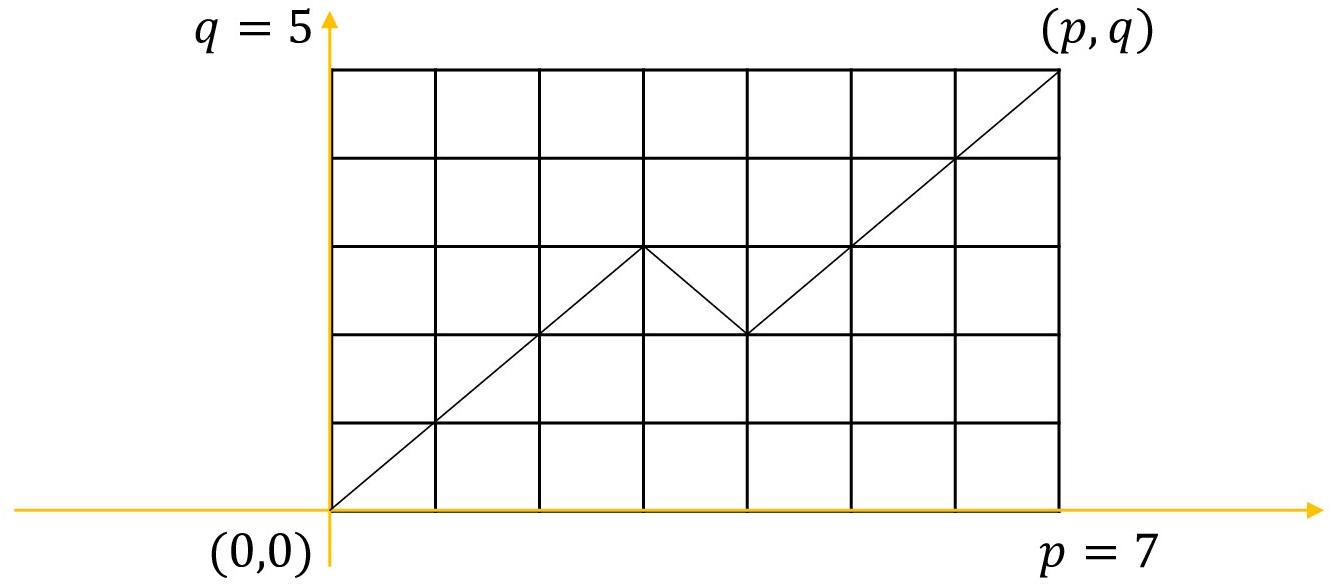
THEOREM: There is a T-route from to only if (1) ; (2) ; and (3) .
- Let be a T-route from to , where .
- ; ;
- ; for every
REMARK: The T-condition (1)+(2)+(3) is sufficient for the existence of a T-route.
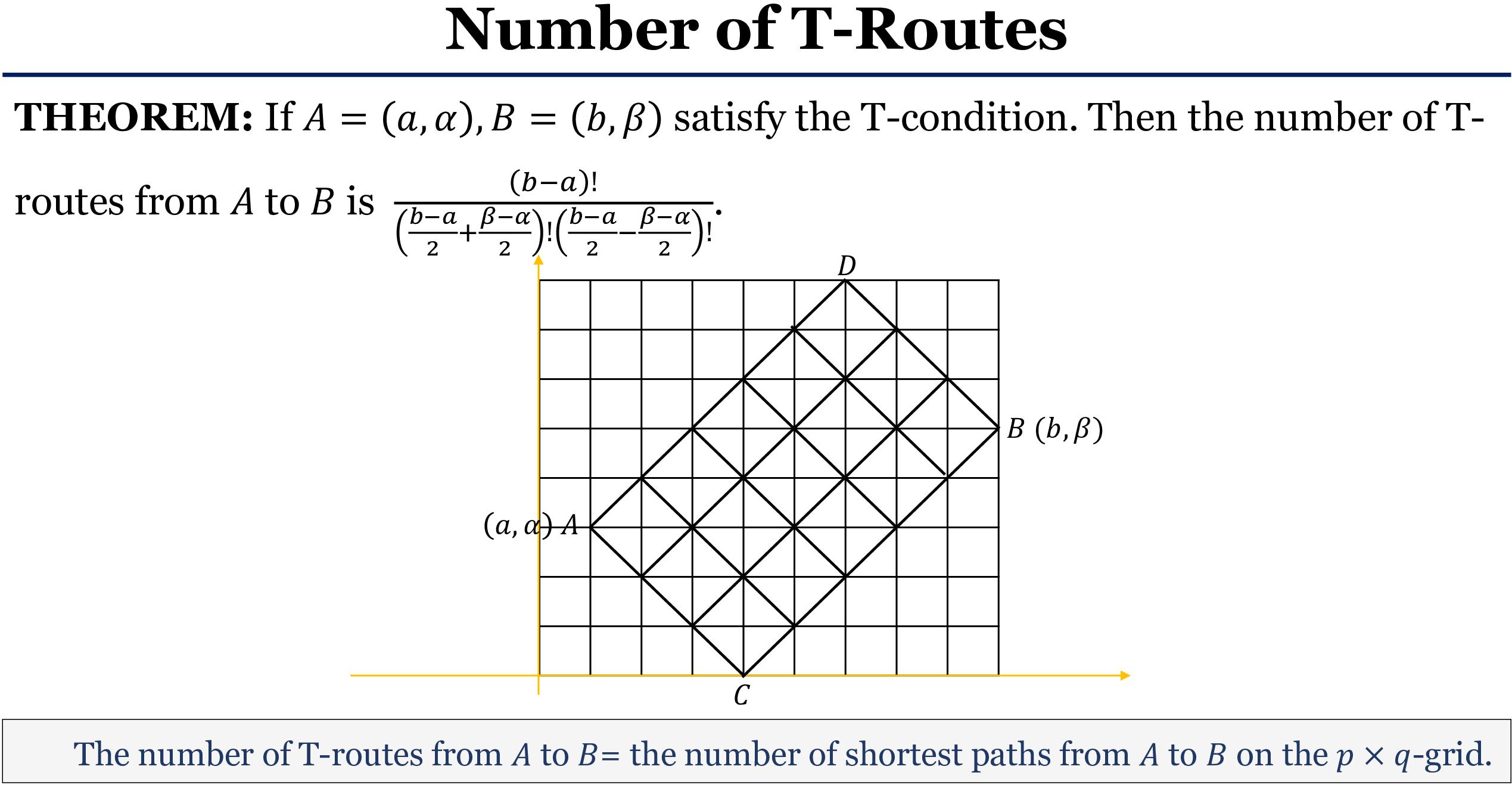
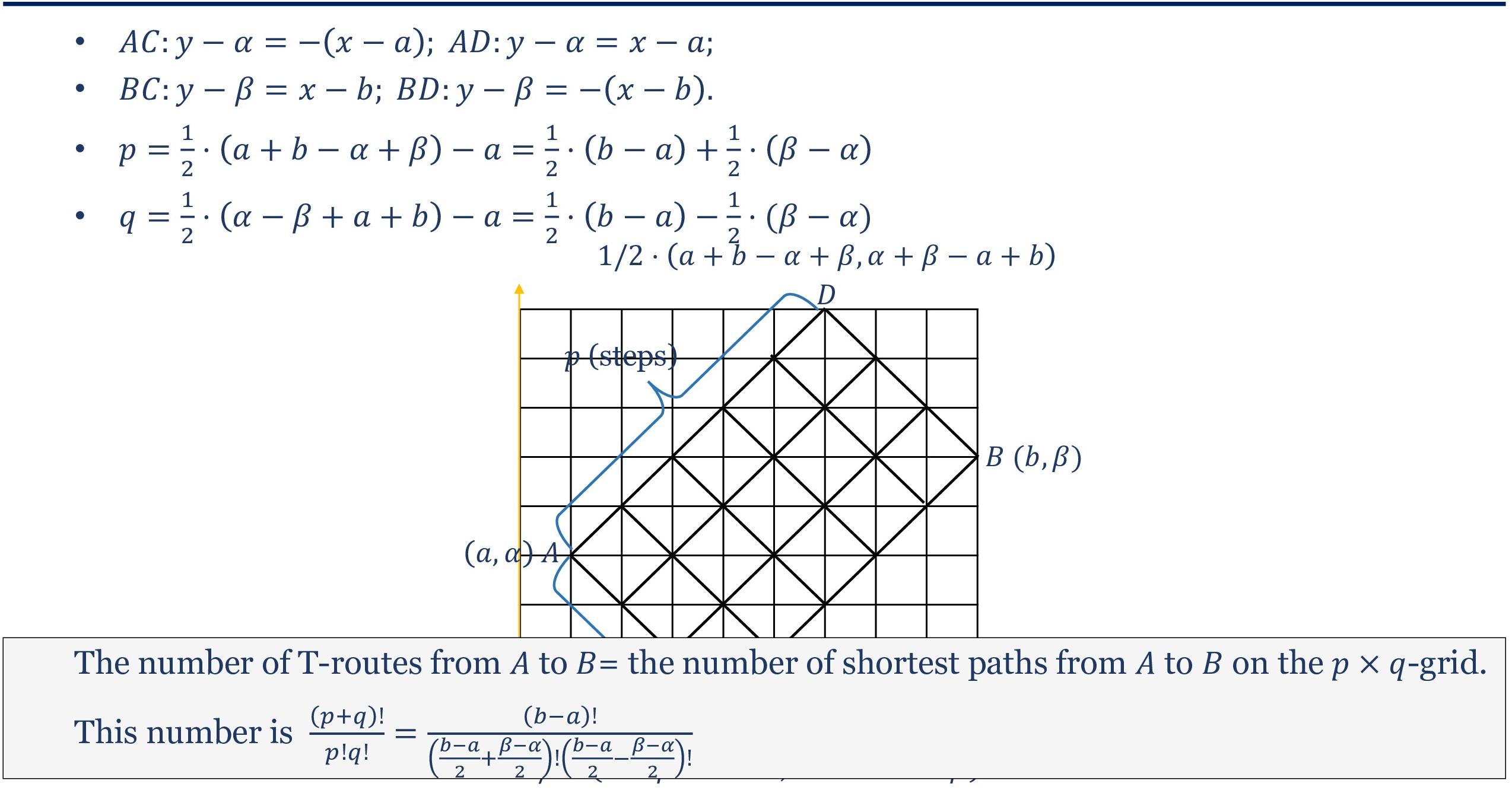
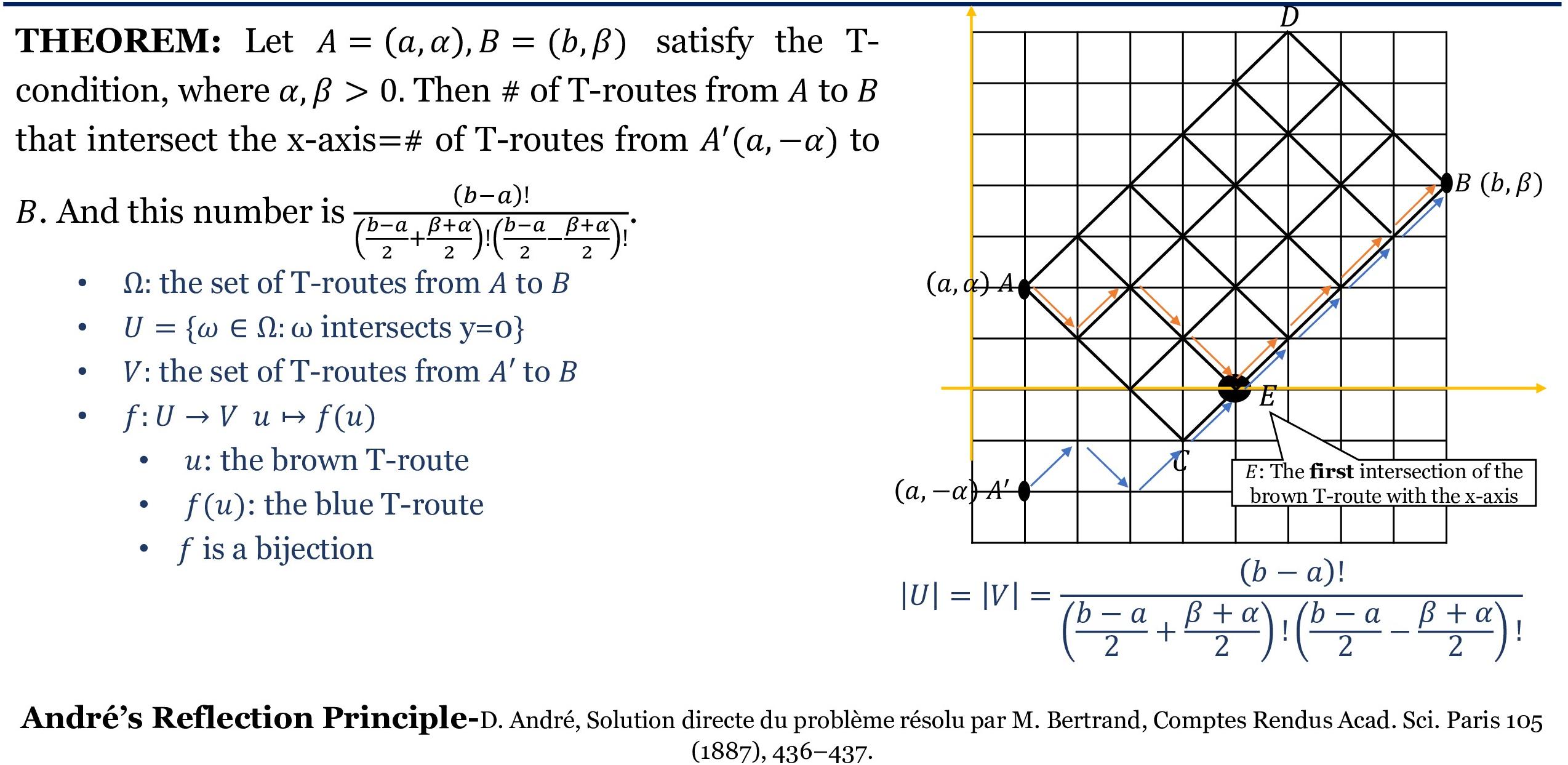
THEOREM: Let satisfy the T-condition, where . Then # of T-routes from to that do not intersect the x-axis is
© 版权声明
文章版权归作者所有,未经允许请勿转载。
相关文章


之前用Catalan数解括号匹配题,调了半小时才AC😭
这递推公式Cn+1那个,有没有大佬讲讲具体怎么推出来的?
画了个n=3的三角剖分,数出来真是5种,Catalan有点意思。
这递推式每次都要从拆边开始想,记不住啊。
感觉讲二叉树那段最通透,一下子串起来了。
T-route和Dyck path应该是一回事吧?一个往上走一个往下走不越界?
之前写算法题用Dyck路径模拟括号匹配,调了一晚上才过。
Catalan数列这几个模型对应起来真神奇,像拼图对上了。