Summary of Lecture 6 𝐄 𝐄 𝐀 ( a , b ) \mathbf{EEA}(a, b) input a , b ( a ≥ b > 0 ) a, b\,(a \ge b > 0) output d = gcd ( a , b ) d = \gcd(a, b) s , t s, t d = a s + b t d = as + bt
r 0 = a ; r 1 = b ; ( s 0 t 0 ) = ( 1 0 ) ; ( s 1 t 1 ) = ( 0 1 ) ; r_0 = a; r_1 = b; \begin{pmatrix} s_0 \\ t_0 \end{pmatrix} = \begin{pmatrix} 1 \\ 0 \end{pmatrix}; \begin{pmatrix} s_1 \\ t_1 \end{pmatrix} = \begin{pmatrix} 0 \\ 1 \end{pmatrix}; r 0 = r 1 q 1 + r 2 ( 0 < r 2 < r 1 ) ; ( s 2 t 2 ) = ( s 0 t 0 ) − q 1 ( s 1 t 1 ) r_0 = r_1q_1 + r_2\,(0 < r_2 < r_1); \begin{pmatrix} s_2 \\ t_2 \end{pmatrix} = \begin{pmatrix} s_0 \\ t_0 \end{pmatrix} – q_1 \begin{pmatrix} s_1 \\ t_1 \end{pmatrix} ⋮ \vdots r i − 1 = r i q i + r i + 1 ( 0 < r i + 1 < r i ) ; ( s i + 1 t i + 1 ) = ( s i − 1 t i − 1 ) − q i ( s i t i ) r_{i-1} = r_iq_i + r_{i+1}\,(0 < r_{i+1} < r_i); \begin{pmatrix} s_{i+1} \\ t_{i+1} \end{pmatrix} = \begin{pmatrix} s_{i-1} \\ t_{i-1} \end{pmatrix} – q_i \begin{pmatrix} s_i \\ t_i \end{pmatrix} ⋮ \vdots r k − 2 = r k − 1 q k − 1 + r k ( 0 < r k < r k − 1 ) ; ( s k t k ) = ( s k − 2 t k − 2 ) − q k − 1 ( s k − 1 t k − 1 ) r_{k-2} = r_{k-1}q_{k-1} + r_k\,(0 < r_k < r_{k-1}); \begin{pmatrix} s_k \\ t_k \end{pmatrix} = \begin{pmatrix} s_{k-2} \\ t_{k-2} \end{pmatrix} – q_{k-1} \begin{pmatrix} s_{k-1} \\ t_{k-1} \end{pmatrix} r k − 1 = r k q k r_{k-1} = r_kq_k output r k , s k , t k r_k, s_k, t_k O ( ℓ ( a ) ℓ ( b ) ) O(\ell(a)\ell(b))
Notations: Ω , Θ , π ( x ) = ∑ p ≤ x 1 , v p ( n ) \Omega, \Theta, \pi(x) = \sum_{p \le x} 1, v_p(n) p v p ( n ) | n , p v p ( n ) + 1 ∤ n p^{v_p(n)} | n, p^{v_p(n)+1} \nmid n
THEOREM (Chebyshev, 1850) π ( x ) = Θ ( x ln x ) \pi(x) = \Theta\left(\frac{x}{\ln x}\right)
LEMMA: Suppose that m ∈ ℤ + m \in \mathbb{Z}^+
( 2 m m ) ≥ 2 2 m 2 m and ( 2 m + 1 m ) ≤ 2 2 m \binom{2m}{m} \ge \frac{2^{2m}}{2m} \text{ and } \binom{2m+1}{m} \le 2^{2m} LEMMA: Suppose that p p n ∈ ℤ + n \in \mathbb{Z}^+
v p ( n ! ) = ∑ k ≥ 1 ⌊ n / p k ⌋ v_p(n!) = \sum_{k \ge 1} \lfloor n/p^k \rfloor THEOREM: Let n ∈ ℤ + n \in \mathbb{Z}^+ n ≥ 2 n \ge 2 π ( n ) ≥ ln 2 2 ⋅ n ln n \pi(n) \ge \frac{\ln 2}{2} \cdot \frac{n}{\ln n}
COROLLARY: π ( x ) = Ω ( x ln x ) \pi(x) = \Omega\left(\frac{x}{\ln x}\right) π ( x ) ≥ ln 2 4 ⋅ x ln x \pi(x) \ge \frac{\ln 2}{4} \cdot \frac{x}{\ln x}
Chebyshev’s Theorem COROLLARY: π ( x ) = Ω ( x ln x ) \pi(x) = \Omega\left(\frac{x}{\ln x}\right)
For any real number x ≥ 2 x \ge 2 π ( x ) ≥ π ( ⌊ x ⌋ ) ≥ ln 2 2 ⋅ ⌊ x ⌋ ln ⌊ x ⌋ ≥ ln 2 2 ⋅ x − 1 ln x ≥ ln 2 4 ⋅ x ln x \pi(x) \ge \pi(\lfloor x \rfloor) \ge \frac{\ln 2}{2} \cdot \frac{\lfloor x \rfloor}{\ln \lfloor x \rfloor} \ge \frac{\ln 2}{2} \cdot \frac{x-1}{\ln x} \ge \frac{\ln 2}{4} \cdot \frac{x}{\ln x} Chebyshev’s theta function: θ ( x ) = ∑ p ≤ x ln p \theta(x) = \sum_{p \le x} \ln p // θ ( 5.2 ) = ln 2 + ln 3 + ln 5 = ln 30 \theta(5.2) = \ln 2 + \ln 3 + \ln 5 = \ln 30
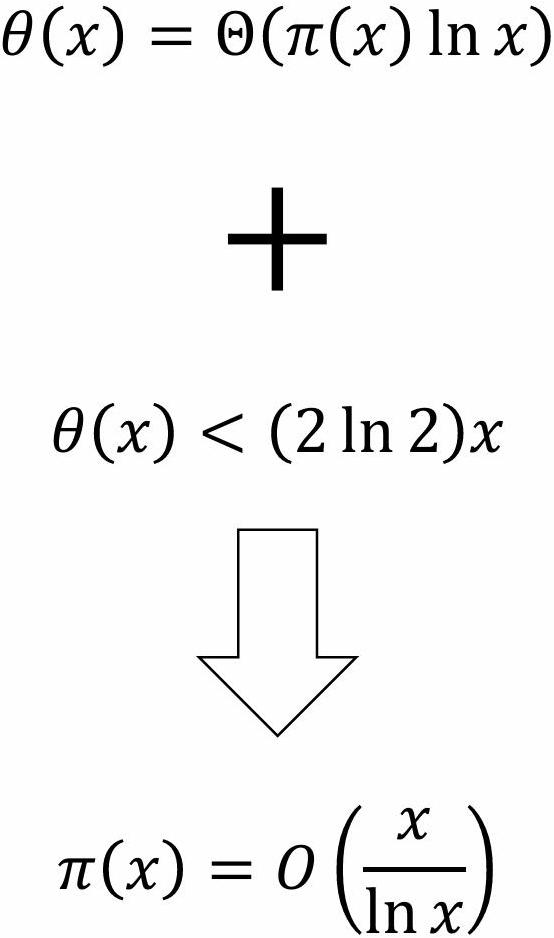
THEOREM: θ ( x ) = Θ ( π ( x ) ln x ) \theta(x) = \Theta(\pi(x) \ln x)
θ ( x ) ≤ π ( x ) ⋅ ln x \theta(x) \le \pi(x) \cdot \ln x // there are π ( x ) \pi(x) terms in θ ( x ) \theta(x) , each of which is ≤ ln x \le \ln x θ ( x ) ≥ ∑ x < p ≤ x ln p \theta(x) \ge \sum_{\sqrt{x} < p \le x} \ln p ≥ ( π ( x ) − x ) ln x \ge (\pi(x) – \sqrt{x}) \ln \sqrt{x} // there are at least π ( x ) − x \pi(x) – \sqrt{x} terms in the sum ∑ x < p ≤ x ln p \sum_{\sqrt{x} < p \le x} \ln p , each ≥ ln x \ge \ln \sqrt{x} = 1 2 ( 1 − x π ( x ) ) π ( x ) ln x = \frac{1}{2} \left( 1 – \frac{\sqrt{x}}{\pi(x)} \right) \pi(x) \ln x π ( x ) ≥ ln 2 4 ⋅ x ln x ⇒ x π ( x ) ≤ 4 ln x x ln 2 → 0 \pi(x) \ge \frac{\ln 2}{4} \cdot \frac{x}{\ln x} \Rightarrow \frac{\sqrt{x}}{\pi(x)} \le \frac{4 \ln x}{\sqrt{x} \ln 2} \to 0 x → ∞ x \to \infty x π ( x ) < 1 2 \frac{\sqrt{x}}{\pi(x)} < \frac{1}{2} x x x ≥ x 0 x \ge x_0 θ ( x ) ≥ 1 4 π ( x ) ln x \theta(x) \ge \frac{1}{4} \pi(x) \ln x x ≥ x 0 x \ge x_0 THEOREM: For any integer n ≥ 1 , θ ( n ) < ( 2 ln 2 ) n n \ge 1, \theta(n) < (2 \ln 2)n
n = 1 : θ ( 1 ) = 0 < ( 2 ln 2 ) ⋅ 1 n = 1: \theta(1) = 0 < (2 \ln 2) \cdot 1 n = 2 : θ ( 2 ) = ln 2 < ( 2 ln 2 ) ⋅ 2 n = 2: \theta(2) = \ln 2 < (2 \ln 2) \cdot 2 n = 3 : θ ( 3 ) = ln 2 + ln 3 < ( 2 ln 2 ) ⋅ 3 n = 3: \theta(3) = \ln 2 + \ln 3 < (2 \ln 2) \cdot 3 ln 6 < ln 2 6 \ln 6 < \ln 2^6 n > 3 n > 3 2 | n 2|n θ ( n ) = θ ( n − 1 ) < ( 2 ln 2 ) ( n − 1 ) < ( 2 ln 2 ) n \theta(n) = \theta(n-1) < (2 \ln 2)(n-1) < (2 \ln 2)n n > 3 n > 3 2 ∤ n 2 \nmid n m ≥ 2 m \ge 2 n = 2 m + 1 n = 2m + 1 M = ( 2 m + 1 m ) = ( 2 m + 1 ) ⋯ ( m + 2 ) m ! < 2 2 m M = \binom{2m+1}{m} = \frac{(2m+1)\cdots(m+2)}{m!} < 2^{2m} Any prime p , m + 1 < p ≤ 2 m + 1 p, m+1 < p \le 2m+1 M M θ ( 2 m + 1 ) − θ ( m + 1 ) = ∑ m + 1 < p ≤ 2 m + 1 ln p \theta(2m+1) – \theta(m+1) = \sum_{m+1 < p \le 2m+1} \ln p ≤ ln M \le \ln M < ( 2 ln 2 ) m < (2 \ln 2)m θ ( n ) = θ ( 2 m + 1 ) − θ ( m + 1 ) + θ ( m + 1 ) \theta(n) = \theta(2m+1) – \theta(m+1) + \theta(m+1) < ( 2 ln 2 ) m + ( 2 ln 2 ) ( m + 1 ) < (2 \ln 2)m + (2 \ln 2)(m+1) = ( 2 ln 2 ) n = (2 \ln 2)n THEOREM: For any real number x ≥ 1 , θ ( x ) < ( 2 ln 2 ) x x \ge 1, \theta(x) < (2 \ln 2)x θ ( x ) = θ ( ⌊ x ⌋ ) < ( 2 ln 2 ) ⌊ x ⌋ < ( 2 ln 2 ) x \theta(x) = \theta(\lfloor x \rfloor) < (2 \ln 2)\lfloor x \rfloor < (2 \ln 2)x
Prime Number Theorem DEFINITION: For x ∈ ℝ + x \in \mathbb{R}^+ π ( x ) = ∑ p ≤ x 1 \pi(x) = \sum_{p \le x} 1 # \# ≤ x \le x
THEOREM (Hadamard;Poussin,1896) lim x → ∞ π ( x ) x ln x = 1 \lim_{x \to \infty} \frac{\pi(x)}{\frac{x}{\ln x}} = 1
Conjectured by Legendre and Gauss (1777-1855) in 1791, proved independently by Hadamard (1865-1963) and de la Vallée Poussin (1866-1962) in 1896 Chebyshev: if the limit exists, then it is equal to 1 1 Rosser (1907-1989) and Schoenfeld (1920-2002) proved in 1962:π ( x ) > x ln x ( 1 + 1 2 ln x ) \pi(x) > \frac{x}{\ln x} (1 + \frac{1}{2 \ln x}) x ≥ 59 x \ge 59 π ( x ) < x ln x ( 1 + 3 2 ln x ) \pi(x) < \frac{x}{\ln x} (1 + \frac{3}{2 \ln x}) x > 1 x > 1 NOTATION: ℙ \mathbb{P} ℙ n = { p ∈ ℙ : 2 n − 1 ≤ p < 2 n } \mathbb{P}_n = \{p \in \mathbb{P} : 2^{n-1} \le p < 2^n\}
THEOREM: | ℙ n | ≥ 2 n n ln 2 ( 1 2 + O ( 1 n ) ) |\mathbb{P}_n| \ge \frac{2^n}{n \ln 2} \left(\frac{1}{2} + O\left(\frac{1}{n}\right)\right) n → ∞ n \to \infty
EXAMPLE: The number of n n n ∈ { 10 , … , 25 } n \in \{10, …, 25\}
n n | ℙ n | |\mathbb{P}_n| 2 n − 1 n ln 2 \frac{2^{n-1}}{n} \ln 2 n n | ℙ n | |\mathbb{P}_n| 2 n − 1 n ln 2 \frac{2^{n-1}}{n} \ln 2 10 75 73.8 18 10749 10505.4 11 137 134.3 19 20390 19904.9 12 255 246.2 20 38635 37819.4 13 464 454.6 21 73586 72036.9 14 872 844.2 22 140336 137525.0 15 1612 1575.8 23 268216 263091.4 16 3030 2954.6 24 513708 504258.5 17 5709 5561.7 25 985818 968176.3
Prime Number Generation Basic Idea: randomly choose n n
The number of n n 2 n − 1 2^{n-1} | ℙ n | ≥ 2 n n ln 2 ( 1 2 + O ( 1 n ) ) |\mathbb{P}_n| \ge \frac{2^n}{n \ln 2} \left(\frac{1}{2} + O\left(\frac{1}{n}\right)\right) n → ∞ n \to \infty The probability that a prime is chosen in every trial is equal toα n = 1 n ln 2 ( 1 + O ( 1 n ) ) , n → ∞ \alpha_n = \frac{1}{n \ln 2} \left(1 + O\left(\frac{1}{n}\right)\right), n \to \infty In α n − 1 = n ln 2 1 + O ( 1 n ) ≤ 2 n ln 2 \alpha_n^{-1} = \frac{n \ln 2}{1 + O\left(\frac{1}{n}\right)} \le 2n \ln 2 Efficient Algorithms: An algorithm is considered as efficient if its (expected) running time is a polynomial in the bit length of its input.//a.k.a. (expected) polynomial-time algorithm
Expected complexity: Choosing an n n
The expected # \# ≤ 2 n ln 2 \le 2n \ln 2 n n Determine if an n n THEOREM: An integer n ≥ 1 n \ge 1 a n − 1 ≡ 1 ( mod n ) a^{n-1} \equiv 1 \pmod{n} a = 1 , 2 , … , n − 1 a = 1, 2, \dots, n-1
⟹ \implies ⟹ \implies n = k l n = kl k n − 1 ≡ 1 ( mod n ) k^{n-1} \equiv 1 \pmod{n} Fermat test: 𝐅 𝐞 𝐫 𝐦 𝐚 𝐭 ( n , t ) \mathbf{Fermat}(n, t)
Input: an odd integer n ≥ 3 n \ge 3 t ≥ 1 t \ge 1 Output: prime/compositefor i = 1 i = 1 t t choose a random integer a ∈ { 2 , … , n − 2 } a \in \{2, \dots, n-2\} If ( a n − 1 mod n ) ≠ 1 (a^{n-1}\bmod n) \neq 1 return “prime” Analysis: If n n If n n Other test algorithms: Solovay-Strassen, Miller-Rabin, Agrawal-Kayal-Saxena (2002)
Linear Congruence Equations DEFINITION: Let a , b ∈ ℤ , n ∈ ℤ + a, b \in \mathbb{Z}, n \in \mathbb{Z}^+ linear congruence equation is a congruence of the form a x ≡ b ( mod n ) ax \equiv b \pmod n x x
THEOREM: Let n ∈ ℤ + , a ∈ ℤ n \in \mathbb{Z}^+, a \in \mathbb{Z} d = gcd ( a , n ) d = \gcd(a, n) a x ≡ b ( mod n ) ax \equiv b \pmod n d | b d\mid b
⟹ \implies a x 0 ≡ b ( mod n ) ax_0 \equiv b \pmod n x 0 ∈ ℤ x_0 \in \mathbb{Z} ∃ z ∈ ℤ \exists z \in \mathbb{Z} a x 0 − b = n z ax_0 – b = nz b = a x 0 − n z b = ax_0 – nz d | a , d | n ⟹ d | b d\mid a, d\mid n \implies d\mid b ⟸ \impliedby d | b d\mid b d = gcd ( a , n ) d = \gcd(a, n) ∃ s , t ∈ ℤ \exists s, t \in \mathbb{Z} a s + n t = d as + nt = d b = d z = a s z + n t z b = dz = asz + ntz a ( s z ) ≡ b ( mod n ) a(sz) \equiv b \pmod n s z sz THEOREM: Let n ∈ ℤ + , a ∈ ℤ , gcd ( a , n ) = d , t = ( a d ) − 1 ( mod n d ) n \in \mathbb{Z}^+, a \in \mathbb{Z}, \gcd(a, n) = d, t = \left(\frac{a}{d}\right)^{-1} \pmod{\frac{n}{d}} d | b d\mid b a x ≡ b ( mod n ) ax \equiv b \pmod n x ≡ b d t ( mod n d ) x \equiv \frac{b}{d}t \pmod{\frac{n}{d}}
d = gcd ( a , n ) , d | b d = \gcd(a, n), d\mid b a x ≡ b ( mod n ) ⟺ n | ( a x − b ) ax \equiv b \pmod n \iff n \mid (ax – b) n | ( a x − b ) ⟺ n d | ( a d x − b d ) n \mid (ax – b) \iff \frac{n}{d}\mid \left(\frac{a}{d}x – \frac{b}{d}\right) n d | ( a d x − b d ) ⟺ a d x ≡ b d ( mod n d ) \frac{n}{d} \mid \left(\frac{a}{d}x – \frac{b}{d}\right) \iff \frac{a}{d}x \equiv \frac{b}{d} \pmod{\frac{n}{d}} a d x ≡ b d ( mod n d ) ⟹ t a d x ≡ t b d ( mod n d ) \frac{a}{d}x \equiv \frac{b}{d} \pmod{\frac{n}{d}} \implies t\frac{a}{d}x \equiv t\frac{b}{d} \pmod{\frac{n}{d}} ⟹ x ≡ t b d ( mod n d ) \implies x \equiv t\frac{b}{d} \pmod{\frac{n}{d}} x ≡ t b d ( mod n d ) ⟹ t a d x ≡ t b d ( mod n d ) x \equiv t\frac{b}{d} \pmod{\frac{n}{d}} \implies t\frac{a}{d}x \equiv t\frac{b}{d} \pmod{\frac{n}{d}} ⟹ a d x ≡ b d ( mod n d ) \implies \frac{a}{d}x \equiv \frac{b}{d} \pmod{\frac{n}{d}} t = ( a d ) − 1 ( mod n d ) t = \left(\frac{a}{d}\right)^{-1} \pmod{\frac{n}{d}} t a d ≡ 1 ( mod n d ) t\frac{a}{d} \equiv 1 \pmod{\frac{n}{d}} 1 ≡ t a d ( mod n d ) 1 \equiv t\frac{a}{d} \pmod{\frac{n}{d}} x ≡ t a d x ( mod n d ) x \equiv t\frac{a}{d}x \pmod{\frac{n}{d}} System of Linear Congruences Sun-Tsu’s Question: There are certain things whose number is unknown. When divided by 3, the remainder is 2; when divided by 5, the remainder is 3; and when divided by 7, the remainder is 2. What will be the number of things?
x ≡ 2 ( mod 3 ) x \equiv 2 \pmod{3} x ≡ 3 ( mod 5 ) x \equiv 3 \pmod{5} x ≡ 2 ( mod 7 ) x \equiv 2 \pmod{7} DEFINITION: A system of linear congruences is a set of linear congruence equations of the form
{ a 1 x ≡ b 1 ( mod n 1 ) a 2 x ≡ b 2 ( mod n 2 ) ⋮ a k x ≡ b k ( mod n k ) . \begin{cases}a_1 x \equiv b_1 \pmod{n_1} \\a_2 x \equiv b_2 \pmod{n_2} \\\vdots \\a_k x \equiv b_k \pmod{n_k}\end{cases}. x ∈ ℤ x \in \mathbb{Z} solution if it satisfies all k k 



素数定理证明居然直接略过了,还想看细节呢。
求问那个theta函数的界是怎么推出来的?没太看懂中间那步。
这笔记记得真全,连复杂度分析都有,比我的强多了。
求问 t 值取多少比较稳?怕选小了出 bug。
Carmichael 数真是费马测试的克星,作者咋不提。
中国剩余定理例子能不能再给一个?有点懵。
theta 函数那堆不等式看得我头都大了,跳过!
素数密度收敛这么慢?难怪找大素数那么费劲。
EEA 手算太慢,还是直接上代码吧,累死人。
这笔记公式多到眼花,手机上看简直灾难。
Miller-Rabin 才是正解,费马那个只能当个参考。
伪素数太搞心态了,测半天说是素数结果不是。
模数不互质那部分确实没细讲,感觉是个大坑。
Chebyshev上界其实用组合数估计的。