Catalan Number
THEOREM: The th Catalan number is the number of solutions of the system
and is equal to .
- is the set of all solutions of the system
- : a bijection from to the ballot sequences of length //
- : the set of all T-routes from to above the x-axis//?
- A map Given a solution ,
- Let for all
- for
- ;
- is a T-route above the x-axis
- A map: Given a T-route to above the x-axis, say ,
- : ;
:
Combinations of Sets
DEFINITION: Let and let . An -combination of is simply an -subset of . // for simplicity, we may use
- with
THEOREM: For all and , the number of -combinations of an -element set is .
DEFINITION: Let and let . An -combination (with repetition) of is a multiset of of elements, where are integers and . // for simplicity, we may use
- with
THEOREM: For all and , the number of -combinations (with repetition) of an element set is .
- : the set of all -combinations of with repetition
- : the set of all -combinations of without repetition
- Let and .
- is a bijection. Hence,
THEOREM: The number of natural number solutions of the equation is .
- and
- : the set of all -combinations of with repetition
- is a bijection. Hence, .
Combinations of Multiset
DEFINITION: Let be an -multiset. Let . An -combination of is an -subset (multiset) of .
- , where for every and .
EXAMPLE:
- is a 3-combination of ; a 3-subset of
REMARK: understanding combinations of a set with those of a multiset
- For every , an -combination of without repetition is an -combination of .
- For every , an -combination of with repetition is an -combination of .
Inverse Binomial Transform
DEFINITION: The binomial transform of is a sequence s.t.
DEFINITION: The inverse binomial transform of is a sequence s.t.
QUESTION: Given (1), how to find the sequence ?
- Answer: is the inverse binomial transform of
- Application: determine via
Combinatorial Proofs
DEFINITION: A combinatorial proof of an identity is
- a double counting proof, showing that count the same set but in different ways:
- and count in different ways.
- a bijective proof, which shows a bijection between the sets counted by and :
- and there is a bijection .
EXAMPLE:
- contains 0’s contains 1’s
LEMMA: for any such that .
- Let be a finite set of elements
- Let
- choose then choose :
- choose then choose :
LEMMA: .
- as
LEMMA: Let . Then
| \ | | | | | | row sum |
|---|
| | | | | | |
| | | | | | |
| | | | | | |
| | | | | | |
| | | | | | |
| col sum | | | | | | |
THEOREM: Let be two sequences s.t. for all , . Then
.
Distribution Problems
The Problem Statement: distributing objects into boxes
- Objects may be distinguishable (labeled with) or indistinguishable (unlabeled)
- Boxes may be distinguishable (labeled with ) or indistinguishable (unlabeled)
- What is the number of methods of distributing objects into ?
| Problem Type | Objects | Boxes |
|---|
| 1 | labeled | labeled |
| 2 | unlabeled | labeled |
| 3 | labeled | unlabeled |
| 4 | unlabeled | unlabeled |
Problem Classification
Type 1
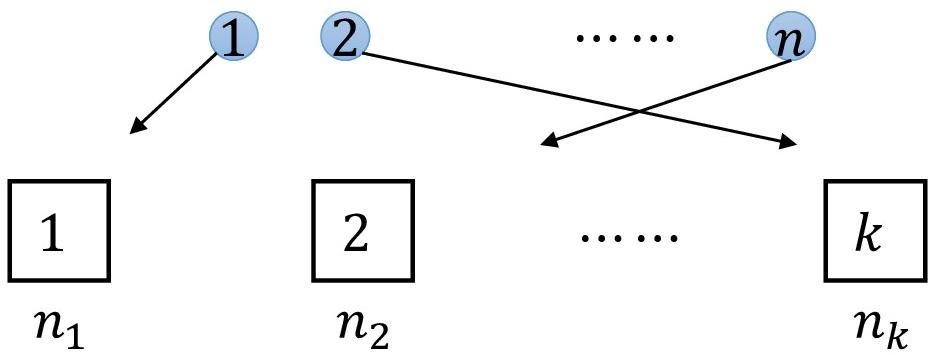
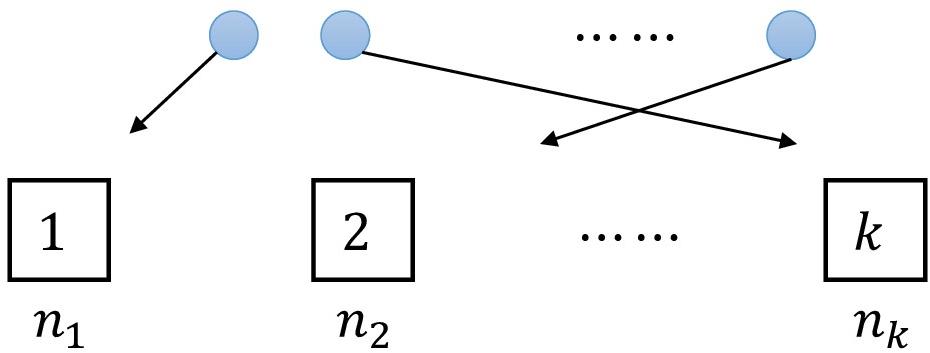
Problem: distributing labeled objects into labeled boxes
 Classifications
THEOREM: The # of ways of distributing labeled objects into labeled boxes such that objects are placed into box for every is .
- : the set of the expected distributing schemes
REMARK: # of permutations of
Type 2
Problem: distributing unlabeled objects into labeled boxes
Classifications
THEOREM: The number of ways of distributing unlabeled objects into labeled boxes is .
- : the set of the expected distributing schemes
- a scheme where objects are put into box
- is a bijection. Hence,
REMARK: # of -combinations of


逆二项变换听着就很高级
要是考试考这个就惨了
感觉组合证明比代数推导直观
Type1和Type2的区别在哪